मुख्य बिंदु
- Dr. Avnish Rahi’s ‘Main Bhookh Hoon’ Opens a New Chapter in Literature, Launched by Saina Nehwal पर विस्तृत जानकारी और ताज़ा अपडेट।
- सरकारी अधिकारियों और ज़मीनी संवाददाताओं के मुख्य बयान।
- ऐतिहासिक संदर्भ और बाज़ार/सामाजिक प्रभाव का विश्लेषण।
- नीचे पूरा विस्तृत विवरण पढ़ें।
Rahi
receives the Global Literary Innovation Award; 71-poem tri-dimensional
Yug-Kavya-Samhita enters the Golden Book of World Records
New
Delhi, August 23: Literature acquires a deeper relevance when it engages with
the questions and anxieties of its time. Against this backdrop, the grand
launch of “Main Bhookh Hoon: Ek Yug-Kavya-Samhita” (From Bread to Nation: The
Pain of an Era), authored by acclaimed Hindi lyricist, writer and educationist
Dr. Avnish Rahi, emerged as a significant literary moment at the National
Literary Shabdotshav held in New Delhi on August 22.

The
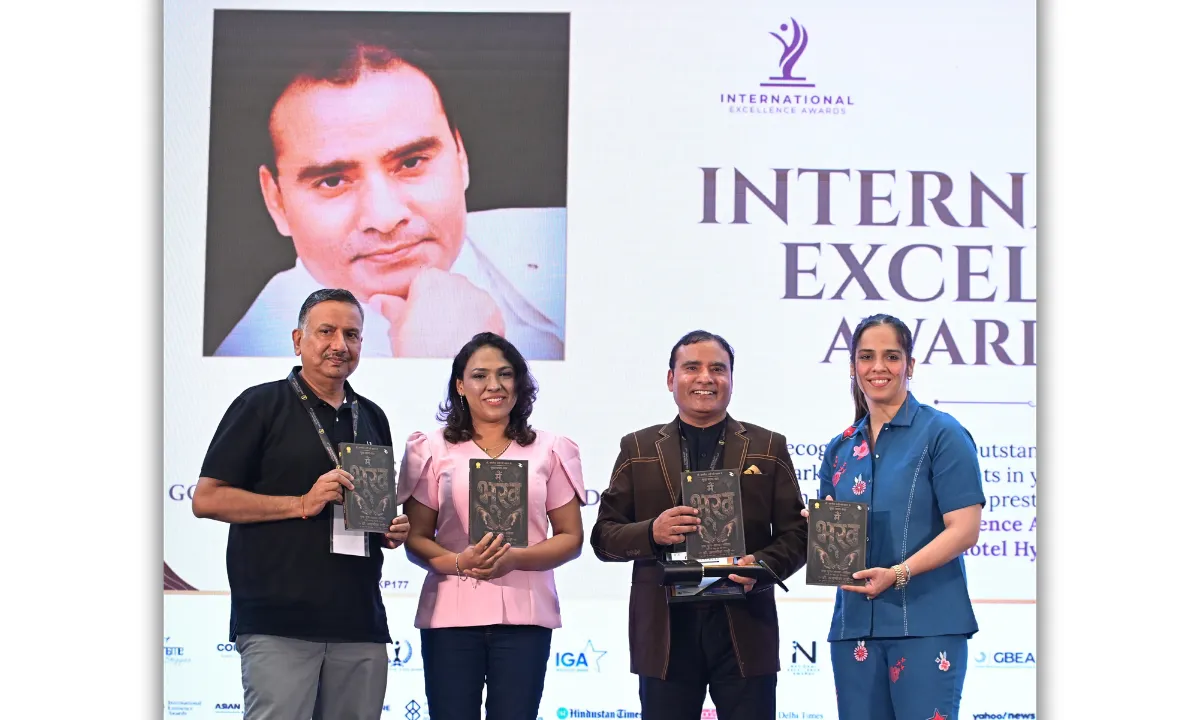
work, created on the literary soil of Aligarh, was formally launched by Padma
Bhushan awardee and internationally acclaimed badminton player Saina Nehwal. On
the same occasion, Dr. Rahi was conferred the “Global Literary Innovation
Award” in recognition of his literary innovation.

Organised
under the aegis of Kitescraft Productions LLP, the ceremony saw Saina Nehwal
honour Dr. Rahi with an angavastram, citation, memento and shawl.
Congratulating him on the world record associated with Main Bhookh Hoon, Nehwal
described the work as an innovative literary initiative that moves beyond the
conventional boundaries of a printed book by making literature readable,
audible and visual. She also highlighted it as an important step towards a new
direction in the presentation of Hindi literature.
The
significance of the occasion extended beyond a book launch and an award
ceremony. A personality who established India’s presence on the global sporting
stage was launching a literary work centred on some of the most fundamental
questions of human existence—basic needs, dignity, justice, opportunity and
equality. Achievement and social sensitivity thus came together on a single
platform.
71
Poems, One Central Question—Hunger
At
the heart of Main Bhookh Hoon is not merely the subject of hunger, but hunger
itself as the central protagonist of the work.
The
hunger begins with bread, but does not end there. It encompasses poverty,
unemployment, education, justice, dignity, opportunity and equality. What
begins as an individual experience gradually becomes a social question and
eventually connects with larger national concerns.
That
is why “From Bread to Nation: The Pain of an Era” is not merely a subtitle. It
represents the intellectual and emotional journey of the entire work.
Here,
hunger is not merely deprivation.
It
becomes a question.
And
when a question takes the form of a song, literature begins a dialogue with its
time.
From
the Printed Page to Sound and Visual Experience
One
of the distinctive features of Main Bhookh Hoon is its tri-dimensional
presentation. The 71-poem Yug-Kavya-Samhita incorporates QR-code-based access
through which readers can not only read the compositions but also listen to and
view them.
The
experience therefore moves beyond the printed page—from word to sound, and from
sound to visual experience.
For
this innovative tri-dimensional literary presentation, Main Bhookh Hoon has
been entered into the Golden Book of World Records, creating a world record
associated with the work.
Yet
the significance of the experiment does not lie in technology alone.
Technology
is the medium; the human question remains at the centre.
That
is what takes Main Bhookh Hoon beyond the achievement of a record and into the
realm of literary discussion.
When
Hunger Becomes a Question
In
Dr. Avnish Rahi’s creative vision, hunger is not confined to any one
individual, class or circumstance. It reaches into those areas of life where
people struggle for their rights, dignity and opportunities.
The
question, therefore, is not simply whether a person has bread to eat.
It
is also:
Did
they receive education?
Did they receive justice?
Did they receive dignity?
Did they receive opportunity?
Did they receive equality?
This
is where the social concern of the work expands into a larger national
discourse.
Hunger
here is not merely a statistic.
It
is an experience.
It
is an aspiration.
And
ultimately, it is a question demanding an answer from society.
Dr.
Avnish Rahi: From Song to a Dialogue with an Era
Emerging
from Dr. Rahi’s literary journey of more than four decades, Main Bhookh Hoon
represents an expansive expression of his engagement with poetry, song and
social concerns.
For
him, the song is not merely a vehicle for personal emotion. It can also become
a medium through which the pain, contradictions and questions of an era find a
voice.
He
expresses the central philosophy of the work in these words:
“Wherever
there is hunger, I am there;
and wherever I am, there are burning questions.”
The
lines offer a key to understanding the intellectual direction of Main Bhookh
Hoon. Hunger here is not merely a need; it becomes a language through which
society is asked to confront its unanswered questions.
From
Aligarh’s Literary Soil to the National Stage
Aligarh
occupies an important place in this journey. The work was conceived and created
in its literary and educational environment, and its national presentation in
New Delhi has brought that creative tradition into a wider literary space.
For
Dr. Rahi, whose literary journey spans more than four decades, Main Bhookh Hoon
brings together traditional Hindi lyricism, social engagement and contemporary
presentation technology.
It
is therefore a meeting point of tradition and innovation—not as opposites, but
as complementary possibilities.
An
Honour That Becomes a Responsibility
Dr.
Avnish Rahi dedicated the honour to his first literary mentor and father,
Mahakavi Amar Singh Rahi.
Speaking
on the occasion, he said:
“For
me, this is a deeply emotional moment. My first lesson in literature came from
my father. I see my entire life’s epic in him. This honour for ‘Main Bhookh
Hoon’ also belongs to all the writers, literature lovers and readers from whom
I have learnt something in one way or another. For me, this honour brings
happiness, but it also carries a greater responsibility—and that responsibility
has now increased.”
The
statement reflects an important dimension of the achievement: recognition is
accompanied by responsibility.
The
ceremony was attended by several personalities from the worlds of literature,
art, education, sport and culture, including Dr. Surbhi Sachin Dhanwala,
Raza-ur-Rehman, Mohammad Badr-uz-Zaman and Anand Prakash.
The
August 22 event brought together four distinct dimensions on one platform—the
launch of a literary work, recognition of its creator, a world-record
achievement and an evolving model of literary presentation.
But
at the centre of them all remained one word:
Hunger.
Can
Literature Give Voice to Hunger?
Perhaps
this is the most important question raised by Main Bhookh Hoon.
Its
answer does not lie in a declaration. It lies in the structure and journey of
the work itself.
It
takes hunger beyond the stomach—to education, justice, dignity, opportunity and
equality—and then places those questions within the larger context of society
and the nation.
That
is the journey at the heart of the work:
From
Bread to Nation.
The
award, the launch and the world-record recognition are visible milestones in
this journey. But the real centre of Main Bhookh Hoon lies beyond those
achievements—in the question that remains alive:
What
are the forms of human hunger that cannot be understood through bread alone?
Perhaps
that is where the literary journey of Main Bhookh Hoon truly begins.
And
where there is hunger, the question of literature begins there.



टिप्पणी लिखें
बातचीत में शामिल होने के लिए कृपया साइन इन करें।
टिप्पणी करने के लिए साइन इन करेंखाता नहीं है? साइन अप करें