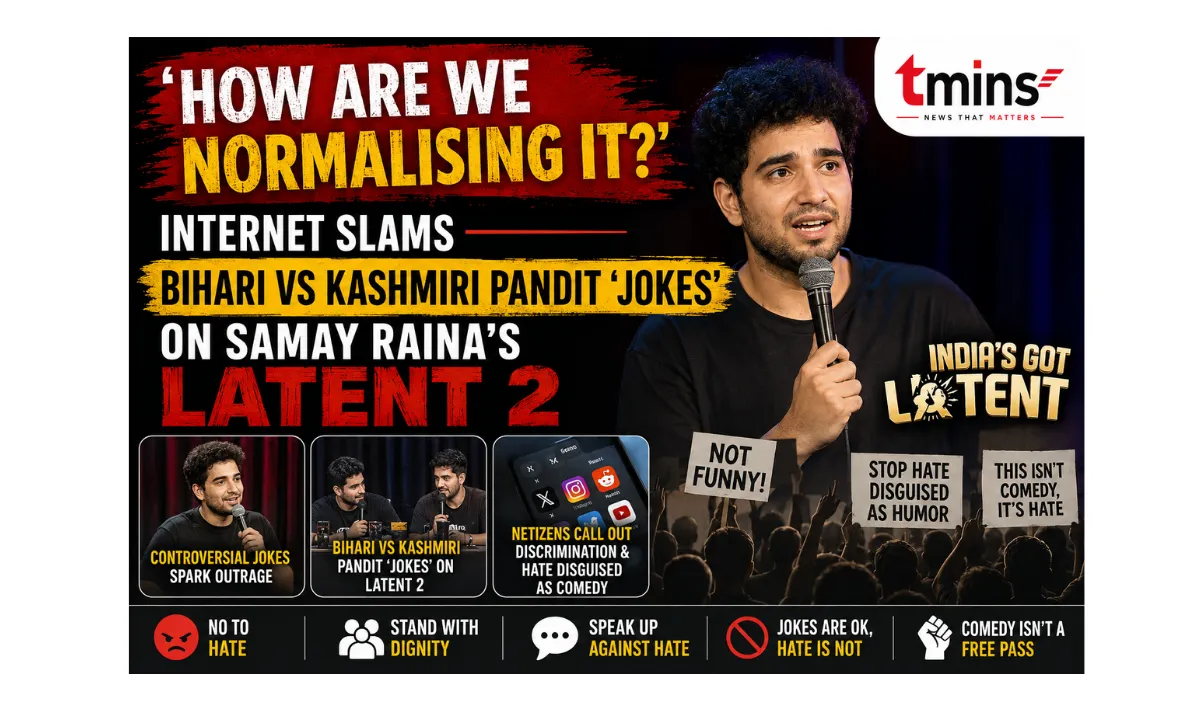
Samay Raina Latent 2: Comedian Samay Raina's show India's Got Latent 2 has sparked a fresh social media debate after jokes involving Bihari and Kashmiri Pandit communities drew criticism online. Several users questioned why jokes based on regional and community identities are increasingly being treated as harmless comedy.
The controversy has reignited a broader discussion about the line between satire and stereotyping, particularly when jokes target people's language, region, ethnicity or community background.
Social Media Users Question the Jokes
Clips and reactions from the episode began circulating online, prompting several viewers to express their discomfort with the content. Critics argued that comedy can address sensitive subjects, but repeatedly relying on stereotypes about particular communities can reinforce prejudices rather than simply make people laugh.
One of the recurring questions among users was: “How are we normalising it?” The criticism reflects growing concern over the way community-based jokes can become normalised when presented under the banner of comedy.
Some users also pointed out that jokes about Biharis have historically been common in Indian popular culture, while references to Kashmiri Pandits can carry additional historical and political sensitivities.
Debate Over Comedy and Offensive Content
The controversy surrounding India's Got Latent 2 is part of a much larger conversation about comedy in the age of social media. Stand-up comedians and online creators often use satire, dark humour and provocative material to generate reactions. However, when clips are shared outside their original context, audiences can interpret the same joke very differently.
Supporters of edgy comedy argue that comedians should be allowed to joke about uncomfortable subjects and that audiences can choose whether they find the material funny. Critics, meanwhile, believe that freedom of expression does not prevent viewers from calling out jokes they consider discriminatory or insensitive.
The latest debate therefore goes beyond one episode and raises a larger question: Should every subject be fair game for comedy, or should comedians exercise greater responsibility when jokes involve historically or socially vulnerable communities?
Samay Raina and India's Got Latent
Samay Raina's India's Got Latent became widely known for its unconventional format, audience interaction and unfiltered humour. The show has repeatedly generated discussions online because of its provocative jokes and controversial moments.
Its popularity has also demonstrated how quickly comedy content can spread on social media. A short clip from an episode can generate thousands of reactions within hours, often bringing the conversation to audiences who may not have watched the complete episode.
In the latest controversy, the reactions have once again highlighted the challenge faced by creators who deliberately operate close to the boundaries of acceptable humour.
Why Community-Based Jokes Remain Sensitive
India is home to hundreds of linguistic, regional, cultural and religious communities. Stereotypes about people from particular states or communities have long appeared in films, television, memes and stand-up comedy.
While many people may treat such jokes as harmless banter, critics argue that repeated stereotypes can influence how communities are perceived. For that reason, jokes involving identity often attract stronger reactions than ordinary observational humour.
The Latent 2 controversy shows that audiences are increasingly willing to challenge such portrayals rather than simply accepting them as comedy.
The Larger Question
Ultimately, the debate surrounding the Bihari and Kashmiri Pandit jokes highlights the constantly changing relationship between comedy, social media and public sensitivity. What one viewer considers satire may be perceived by another as an insult to an entire community.
As online audiences become more vocal, comedians and digital creators are likely to face greater scrutiny over the subjects they choose and the manner in which they present them.
For now, the discussion around India's Got Latent 2 continues to divide social media users, with some defending provocative humour and others asking creators to reconsider where the boundary between comedy and stereotyping should be drawn.




टिप्पणी लिखें
बातचीत में शामिल होने के लिए कृपया साइन इन करें।
टिप्पणी करने के लिए साइन इन करेंखाता नहीं है? साइन अप करें