मुख्य बिंदु
- Odyssey Elevators Promoters Yet to Give Customers Clear Answers on Product Manufacturing Origin and Drum-Winding Technology पर विस्तृत जानकारी और ताज़ा अपडेट।
- सरकारी अधिकारियों और ज़मीनी संवाददाताओं के मुख्य बयान।
- ऐतिहासिक संदर्भ और बाज़ार/सामाजिक प्रभाव का विश्लेषण।
- नीचे पूरा विस्तृत विवरण पढ़ें।
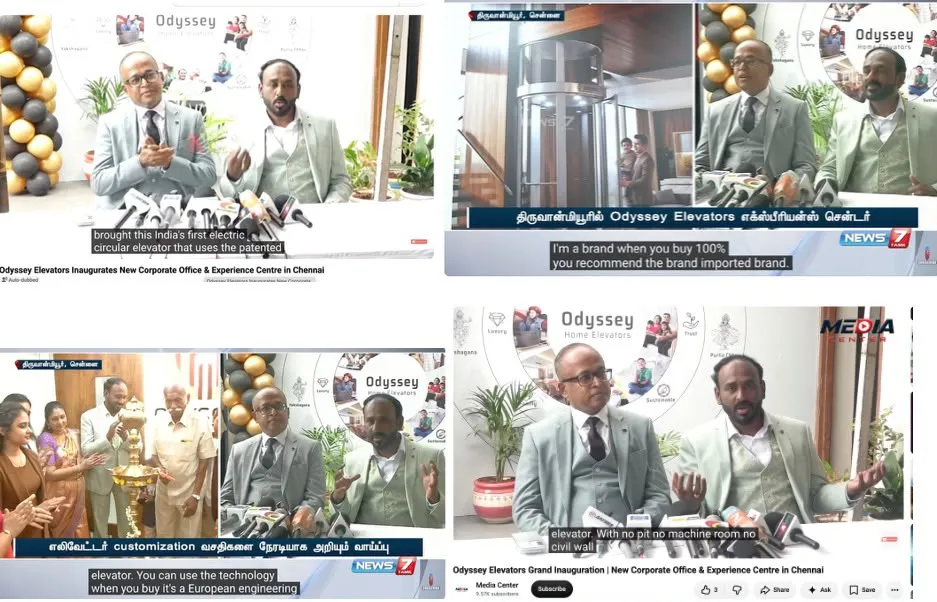
Chennai/Lucknow: As
Odyssey Elevators continues to expand its presence through new experience
centres and showrooms, questions are increasingly being directed not merely at
the brand, but at its promoters and leadership over the
information being communicated to prospective customers about its products.
For a homeowner investing
several lakh rupees in a home elevator, the decision is not based solely on the
appearance of a showroom or the claims made in promotional material. Customers
have a legitimate interest in knowing where the elevator is
manufactured, who actually manufactures it, what technology is being used and
what certification applies to the specific product being sold.
One of the key questions
surrounding Odyssey concerns its description of certain elevators as “electric” and
the technology actually used to lift the cabin. The term “electric” by itself
does not establish the lifting mechanism, since different elevator systems can
be powered by electric motors. The important question for consumers is whether
the particular model being sold uses traction, drum-winding or another
configuration.
Questions have been raised over
whether certain Odyssey elevators described as electric may use drum-winding
technology. Drum-winding systems are an established form of elevator
technology, but that makes accurate disclosure even more important. Customers
should be able to understand exactly what mechanism they are purchasing rather
than having to distinguish between technical terms themselves.
The
Manufacturing-Origin Question
Another issue requiring greater
clarity is the country and location of manufacture.
Marketing terminology such as
“European engineering,” “international technology” or references to imported
components can potentially leave customers with different impressions about
where the complete elevator is actually manufactured.
There is an important
distinction between a product being engineered in one country, containing
components from another country, being manufactured overseas and being
assembled locally.
For a premium home elevator,
customers should not have to rely on assumptions. They should be able to ask
the promoters directly:
Where is the complete elevator
manufactured? Who is the actual manufacturer? What is the manufacturing
facility's address? Which components are imported? From which country? Where
does final assembly take place?
These are straightforward
product-origin questions, particularly when international manufacturing and
technology form part of the brand's marketing proposition.
Why
Should Customers Have to Ask Repeatedly?
The larger consumer issue is
transparency.
A homeowner purchasing a home
elevator may not be an elevator engineer. They may not know the technical
differences between traction and drum-winding systems, or between a
manufacturer's certification and certification applicable to a specific
elevator model.
That is precisely why the
responsibility for providing clear information rests with the companies and
promoters selling the product.
If Odyssey's elevators use
drum-winding technology, there is nothing inherently confusing about stating it
clearly. If the products are manufactured in a particular country, that
information can be documented. If a specific certification covers the elevator
model being sold, the relevant documentation can be made available to
prospective customers.
The question is therefore not
whether a particular technology is old or new. The question is whether
consumers are being given complete and accurate information before they make a
high-value purchase.
Promoters
Have an Opportunity to Provide Clarity
As Odyssey expands its showroom
network in Chennai, Lucknow and other markets, its promoters have an
opportunity to address these questions directly and eliminate uncertainty for
customers.
Publishing the relevant
manufacturing details, identifying the actual manufacturer, clearly specifying
the lifting mechanism used in each model and providing product-specific
certification documents would allow customers to make an informed decision based
on documentation rather than marketing terminology.
A showroom can demonstrate the
appearance, design and operation of an elevator. But transparency about
manufacturing origin, technology and certification ultimately comes from the
documentation behind the product.
For consumers, the questions
remain straightforward: Where is the product manufactured? What
mechanism actually lifts the cabin? What certification applies to the exact
model being sold? And can the promoters provide documentary evidence to support
the claims being made?
Until these questions are clearly addressed, prospective customers are likely to continue seeking greater transparency from the people promoting and selling the elevators.



टिप्पणी लिखें
बातचीत में शामिल होने के लिए कृपया साइन इन करें।
टिप्पणी करने के लिए साइन इन करेंखाता नहीं है? साइन अप करें