
मुख्य बिंदु
- August 12 Total Solar Eclipse: NASA Mission Could Reveal New Details About the Sun’s Corona पर विस्तृत जानकारी और ताज़ा अपडेट।
- सरकारी अधिकारियों और ज़मीनी संवाददाताओं के मुख्य बयान।
- ऐतिहासिक संदर्भ और बाज़ार/सामाजिक प्रभाव का विश्लेषण।
- नीचे पूरा विस्तृत विवरण पढ़ें।
A rare total solar eclipse will sweep across parts of the Northern Hemisphere on August 12, 2026, giving scientists an extraordinary opportunity to study the Sun’s outer atmosphere. While total solar eclipses are spectacular to watch, this event is also expected to provide researchers with valuable data about solar activity that is difficult to capture under normal conditions.
When and Where Will the Total Solar Eclipse Be Visible?
The total solar eclipse on August 12 will pass across Greenland, Iceland, northern Russia, the Atlantic Ocean, Spain and a small part of Portugal. A partial eclipse will be visible across much larger areas, including parts of Europe, Canada, the northern United States and northwestern Africa.



For people located along the path of totality, the Moon will completely cover the Sun for a short period, turning daytime skies dramatically dark.
The total phase will last less than two and a half minutes even near the central part of the eclipse path, according to NASA.
What Will Scientists Look For?
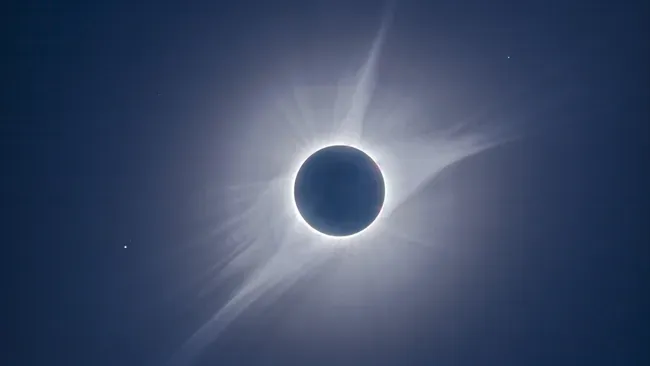
The most important scientific target will be the solar corona, the Sun’s extremely hot outer atmosphere. Normally, the bright surface of the Sun overwhelms the much fainter corona, making it difficult to study from Earth. During totality, however, the Moon blocks the Sun’s bright disk and allows the corona to become visible.
NASA-funded researchers are planning to use the unusual darkness created by the eclipse to investigate the corona and better understand how the Sun behaves.
One of the most ambitious experiments involves a WB-57 research aircraft flying at high altitude and following the Moon’s shadow. By operating above much of Earth's atmosphere, the aircraft can collect observations for longer and with specialized instruments.
Why Is the Corona So Important?
The solar corona reaches temperatures of more than 1 million degrees Celsius, even though the Sun’s visible surface is much cooler. Understanding why the corona becomes so hot remains one of the major questions in solar physics.
Scientists are particularly interested in the Sun’s magnetic activity and explosive phenomena. Better observations could help researchers understand processes that ultimately influence space weather, which can affect satellites, astronauts, communications and power infrastructure.
A Rare Scientific Opportunity
The August 12 eclipse is the first total solar eclipse visible from Earth since April 2024, making it an eagerly anticipated event for both astronomers and skywatchers.
NASA will also support scientific balloon experiments in Iceland and Spain. These experiments will investigate how the sudden reduction in sunlight during an eclipse affects Earth's atmosphere.
So, while the headline-grabbing spectacle will be the Moon completely covering the Sun, the real scientific prize could be the detailed information researchers collect about the Sun and Earth's atmosphere.
Can the Eclipse Be Seen From India?
India is not on the path of totality for the August 12 eclipse. NASA's visibility map shows the total eclipse crossing Greenland, Iceland, northern Russia, the Atlantic and parts of Spain and Portugal, with partial visibility extending across other regions.
For anyone watching a partial eclipse, proper solar viewing equipment is essential. Looking directly at the Sun without appropriate eye protection can cause serious eye injury.
Conclusion
The August 12, 2026 total solar eclipse is much more than a stunning celestial event. It offers scientists a rare chance to observe the Sun's corona and investigate the processes that drive solar activity. With NASA aircraft and balloon experiments adding to observations from the ground, the eclipse could provide important new insights into our closest star and its influence on Earth.






टिप्पणी लिखें
बातचीत में शामिल होने के लिए कृपया साइन इन करें।
टिप्पणी करने के लिए साइन इन करेंखाता नहीं है? साइन अप करें