मुख्य बिंदु
- NEET Protest Row: Supreme Court Demands Accountability for Alleged Police Brutality पर विस्तृत जानकारी और ताज़ा अपडेट।
- सरकारी अधिकारियों और ज़मीनी संवाददाताओं के मुख्य बयान।
- ऐतिहासिक संदर्भ और बाज़ार/सामाजिक प्रभाव का विश्लेषण।
- नीचे पूरा विस्तृत विवरण पढ़ें।
The Supreme Court sought answers on why no independent probe was ordered into alleged police excesses during recent student protests.
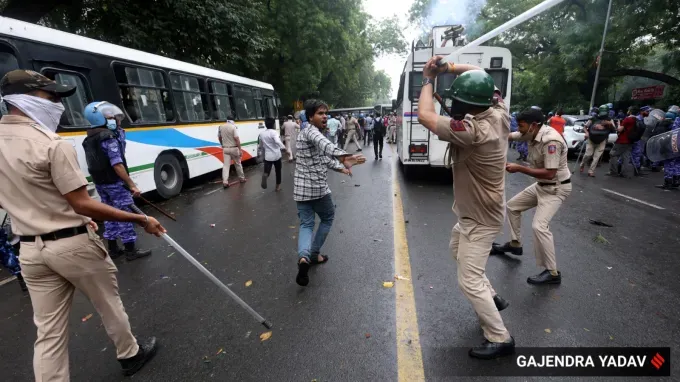
The Supreme Court, on Tuesday raised serious concerns about there not being any independent investigation into the allegations that the police showed excesses during the recent student protests linked to the NEET paper leak controversy and also the examination irregularities. During the hearing, the apex court noted that the constitutional right to peaceful protest has to be protected, and that the use of force by law enforcement agencies cannot just be justified simply because demonstrations are happening.
A bench, led by Chief Justice Surya Kant, agreed to hear a set of petitions alleging police brutality against students who took part in protests across Delhi and several other areas of the country. The petitions say that police personnel used too much force, including baton charges, tear gas, and detentions while dispersing the demonstrators, who were pressing for accountability over the alleged exam paper leak.
While the hearing went on, the cour asked why the authorities hadn’t set up an independent probe into the claims, if what was being described as misconduct by law enforcement officers was really that grave , and somehow managed to grab national attention too. The bench said— in a way that felt quite firm— that peaceful dissent is a key part of a democracy, and it cautioned against treating every public demonstration like it’s automatically a law-and-order threat. In the court’s view, the ability to protest peacefully is protected under the Constitution, and it has to be respected by those authorities.
The whole controversy comes from nationwide student protests that really ramped up after allegations of irregularities in the NEET examination process. Students, youth organizations and opposition parties have been asking for more openness, and better responsibility from the authorities. In multiple demonstrations there were clashes between protesters and police, so people started claiming excessive force happened and that civil liberties got breached. On top of that, human rights organizations have also voiced unease about how the protests were handled. Some reports say security forces used tear gas and batons on demonstrators who were mostly peaceful in certain areas . Rights groups are basically calling for impartial investigations, and they want authorities to make sure that peaceful assemblies are respected, under democratic rules and principles.
Meanwhile, the issue has gained further prominence after a police constable in Bihar's Siwan district was suspended for allegedly firing an AK-47 rifle into the air during a student protest. Videos of the incident circulated widely on social media, drawing criticism from political leaders and civil society groups. Senior officials later described the action as unnecessary and confirmed disciplinary proceedings against the officer.
Apart from allegations of police excesses, courts are also examining concerns related to surveillance of protesters. Activists have challenged the use of AI-powered monitoring systems during demonstrations, arguing that such measures raise privacy concerns and require stronger legal safeguards. The matter is currently under judicial scrutiny and could have broader implications for digital rights and public protests in India.
The Supreme Court indicated that it may consider framing broader national guidelines to prevent future confrontations between protesters and law enforcement agencies. Such guidelines could help balance the constitutional right to peaceful protest with the need to maintain public order. The court is expected to continue hearing the matter as petitions from both protesters and families of police personnel involved in the clashes come up for consideration.
As the debate over police accountability, examination reforms, and democratic rights continues, the Supreme Court's intervention is being closely watched across the country. The outcome of the hearings could influence future standards governing protests, police conduct, and the protection of civil liberties in India.




टिप्पणी लिखें
बातचीत में शामिल होने के लिए कृपया साइन इन करें।
टिप्पणी करने के लिए साइन इन करेंखाता नहीं है? साइन अप करें